Powerful visuals are critical to the cultural narrative around climate change. But portraying its often slow creep without restoring to abstraction, cliche and doom can be challenging. Here’s some advice.
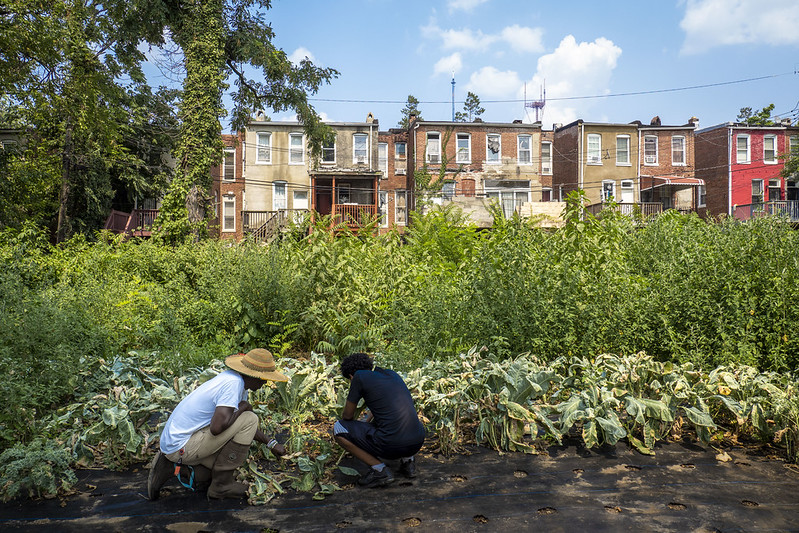
Aspirational photography There are two schools of thought to consider when using solutions focused imagery: it’s good to show mitigation methods in use because they assure audiences they exist, are doing good work and helping tackle climate impacts. But images of these methods—solar panels, windfarms and tree-planting projects and such—have also been found to be the least likely to motivate action. So when curating images for climate storytelling, try to identify behaviours and representations that are aspirational, and promote desirable lifestyles that are also climate-responsible. Whether it’s driving a particular vehicle, adopting certain consumer habits or depicting a scene an audience might want to emulate for themselves, helping viewers link sustainable behaviour to behaviour that is also desirable is a good way to inspire action in the day-to-day.
Plantation Park Heights Urban Farm (PPHUF) in Baltimore, U.S. Photo: USDA/FPAC Photo by Preston Keres
Real people with authentic emotions Any imagery showing identifiable emotions in their subjects can be effective—but staged shots, such as those find in stock libraries, can also be manipulative and inauthentic. When discussing a subject such as climate impacts or its effects, authenticity is important for getting audiences on side and believing what they are seeing is really happening, and to real people. However nuanced, using photojournalism or agency images wherever possible to ensure authenticity in reporting will help add to the credibility and emotional resonance of the impacts being discussed.
Solar powered lighting allows a child to more easily study at home, Sri Lanka. Photo: Dominic Sansoni / World Bank
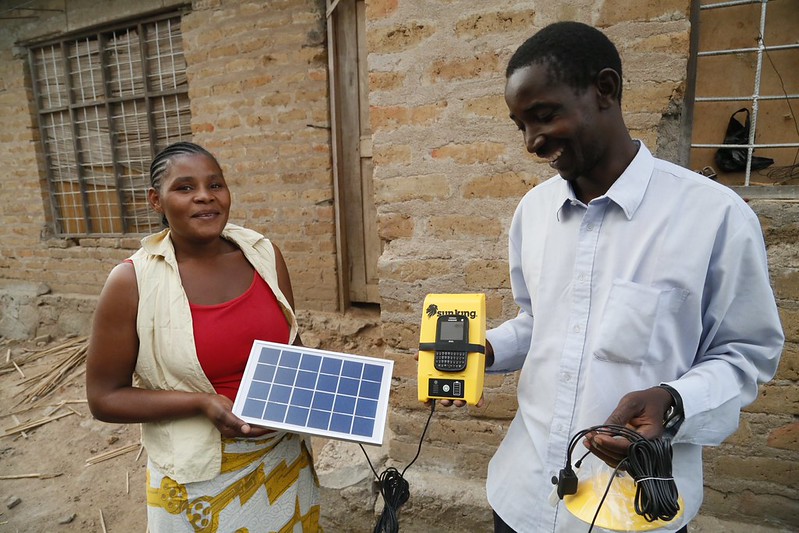
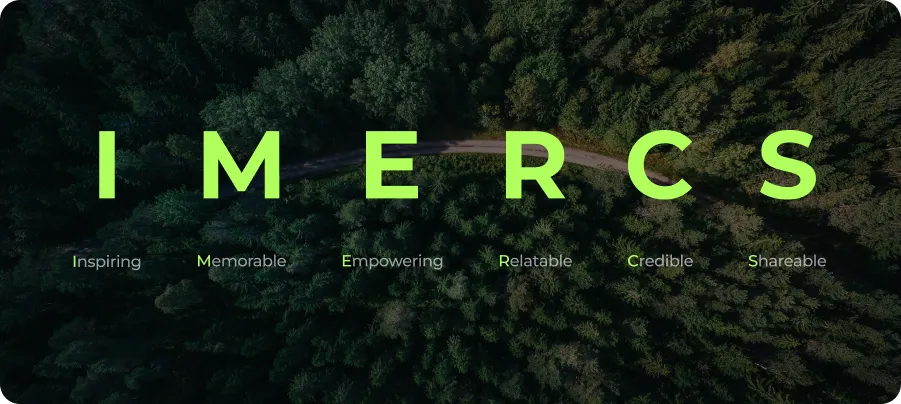
Relatable impacts and situations Research has shown that mainstream media often recruit one of two frames for climate change imagery: the ‘contested’ frame (often showing protest or political discourse) and the ‘distanced’ frame (polar bears, ice melting, desiccated lands) suggesting a far-off, disconnected threat. In order to mount a meaningful response, people must understand how climate change relates to them and their lives—however seemingly subtle the intersection. So framing climate storytelling using cultural cues that are relatable, such as food, transport, the media or lifestyle, and illustrating them as such, is likely to increase relatability.
Local champions for a solar power scheme display the devices they are encouraging residents in a village near Mwanza, Tanzania, to adopt. Photo: Russell Watkins/Department for International Development
Scale over isolated actions Action may start with individual agency; but when it comes to depicting the human causes of climate change, depicting collective behaviours has been shown to be less problematic than singling out one person or one act. Not only does it imply the potential size of the impact is large, it avoids accusatory messaging that may cause a negative response in the audience.
Texas National Guard soldiers conduct rescue operations in flooded areas around Houston, U.S., 2017. Photo by 1 Lt. Zachary West, 100th MPAD / National Guard.
Local impacts with emotional connection It is tempting to think ‘local impacts’ mean ‘small’—and therefore not connected to the whole. But what depicting real people experiencing climate impacts achieves is the understanding that people are witnessing disruption and destruction of the lives they live due to a global issue. This intersection of a worldwide crisis to the things we witness everyday is critical; when balanced correctly it can be very impactful.
What works less
Clichéd imagery Climate change can be hard to visualise. But falling back on the expected visual tropes—polar bears, forest fires, factories spewing pollution, plastic in the ocean—can be self-defeating if the aim is to grab new attention on a stalling subject. The public has habituated to this representation of climate change, and as such any impact these visuals might deliver has lessened. Not only this, the images represent a very narrow aesthetic frame for choice; and so by their inclusion gives the impression that all climate storytelling is essentially the same. We must find new ways to deliver the climate message, and an innovative approach to imagery is a critical part of this.
Protests outside the COP15 Climate Conference in Copenhagen, 2009. Photo: Kris Krüg
Photographs of protests Protest is a critical means of expression and free speech, but many people see this as further complicating the polarisation of climate as a subject. The images are polarising in themselves, as someone can be a supporter of climate action without necessarily being a supporter of climate protests—particularly given the extreme tactics of some groups—which can serve to alienate the public from the climate cause.
Overly distressing images of climate impacts Effective imagery depicting the consequences of climate change strikes a balance between emotional connection and hard-hitting devastation. Too much of the latter can be overwhelming and frightening; too little can lack impact. Similarly, not enough of the human aspect of climate impacts can make images feel detached and unrelatable, while too much distress can cause audiences to disengage. Look for accessibility and identifiable emotional responses when selecting images of this kind.
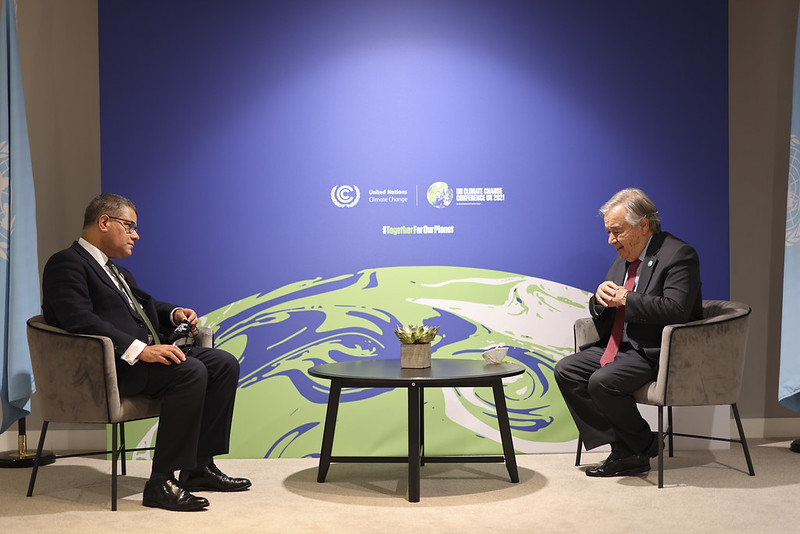
At COP26, UK MP Alok Sharma conducts a bilateral meeting with. Secretary-General of the United Nations, António Guterres. Photo: Tim Hammond / No 10 Downing Street
Images of climate politics People speaking at conferences or summits may have their place when it comes to documenting discourse, but they have little resonance when it comes to inspiring action on climate—and show little of its context or consequence.
Stock images or staged scenarios The visual formula for a stock, or staged, photograph is not difficult to detect, and this goes for audiences as well as editors. Strive for authenticity and don’t simply visualise a concept; document it.
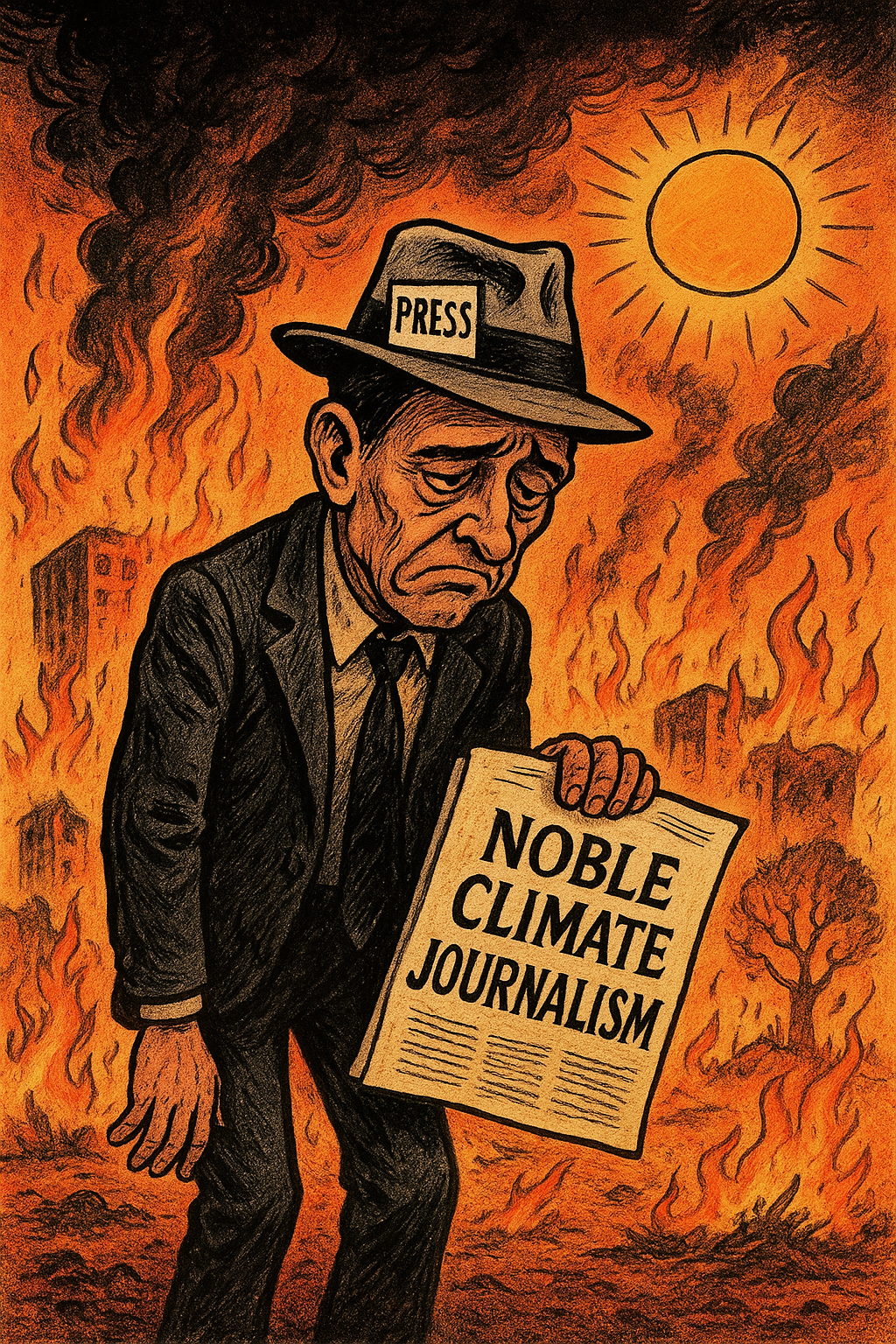
Using artificial intelligence (AI) to produce imagery to accompany climate journalism comes with a number of advantages, disadvantages, and dilemmas. While such technology can be highly useful at creating visuals designed to emphasise concepts, make points and accompany statistics to make the abstract more visual, or creating a realistic image when no photo exists or is available, their value as journalistic tools comes with considerations. Before using AI to create an image, consider the following:
Advantages
Can create an image visualising abstract numbers or concepts
Easy and financially cost-effective for newsrooms
Fast, paperwork-free
Eyecatching and often hyper-realistic
Customisable and ‘made to order’
Does not require photographic consent
Disadvantages
Uses significant energy to produce
Is not evidence, merely an interpretation
Can aid the spread of misinformation if misused
May be generated using unethically-sourced data
Could weaken the authority of an article
Lacks human artistic skill and appeal
Devalues authentic documentary photography and art
With these issues in mind, cXc has produced this Code of Practice for using AI imagery as part of a journalistic workflow: beta guidelines that will enable newsrooms to make informed decisions about the use of such imagery in their work. This code covers video and imagery, and is designed to protect editorial integrity while allowing responsible use of emerging tools. It is updated frequently. Last update: 11 November 2025.
Image generated by AI.
cXc AI Imagery Code of practice
Core Principles
Transparency is paramount All descriptive AI-generated material must be clearly labelled as such, regardless of context or usage. AI imagery is illustrative, never evidential It should visualise concepts, not substitute for documentary photography of real events. Always ask this question: “AI-generated content may be the easiest option. But is it the best option in this particular case?”
Suggested Uses
AI-generated imagery may be used to:
Visualise abstract data (temperature trends, emissions statistics, projected scenarios)
Illustrate scientific concepts or processes not easily photographed
Depict future scenarios or historical reconstructions where no photography exists
Create explanatory graphics or infographics
Uses we discourage
AI-generated imagery should not be used to:
Depict actual news events, disasters, or incidents as if they were photographed
Represent specific, identifiable people or locations without clear fictional framing
Replace commissioned photography when authentic documentation is possible
Constitute evidence of environmental damage or events
Best Practices
Labelling
Every AI image must carry a visible label: ‘AI-Generated Image’ or similar
Labels must appear on the image itself or in immediately adjacent caption text
Labels must be clear in all formats (web, mobile, social media, print)
Editorial Review
Editor approval required before publication
Assessment of whether authentic photography should be used instead
Verification that the image accurately represents stated data or concepts
Sourcing Standards
Document the AI tool used and generation date
Favour tools with transparent machine training data policies
Avoid tools known to use unlicensed creative works
Ethical considerations
Environmental Impact: Balance the energy cost of generation against editorial necessity. Avoid generating multiple iterations: each image can cost as much electricity as charging a smartphone.
Accuracy: AI images depicting environmental scenarios must align with scientific consensus and reputable sources. Avoid sensationalism or misrepresentation.
Artistic Credit: When AI outputs clearly mimic artistic styles—either by design or by accident—consider whether the use is appropriate.
Supporting Journalism: Prioritise commissioning authentic photography for field reporting. Reserve AI use for abstract or illustrative needs.
These libraries and organisations offer imagery that are either free, open source public domain or offer permissive licenses for editorial use. Check each individual image for any restrictions.








.jpg)
